Your cart
Your cart is empty
Continue shoppingDrawer menu

Last Updated: September 15, 2026
Choosing between diamond shapes is a study in optical illusion, and it starts with an honest look at your own hand. Choosing between diamond shapes is a study in optical illusion, and it starts with an honest look at your own hand. A diamond's outline, its facet arrangement, and the way its band meets the finger all work together to make a hand look longer, more balanced, or more delicate. A diamond's outline, its facet arrangement, and the way its band meets the finger all work together to make a hand look longer, more balanced, or more delicate. Get the geometry right and a modest carat weight reads as generous; get it wrong and even a large stone can make a short finger look shorter.
Most guides treat "finger type" as one thing. It's not. Hand size and finger length are separate variables needing separate fixes.
A person can have long fingers on a small hand, or short fingers on a broad palm. Finger length decides whether you want vertical lines or soft curves in the stone's outline; hand size decides how much finger coverage the ring can carry. A large oval on a small hand can look like it's wearing the person; a small round brilliant on a long hand can disappear entirely.
Work out both before you shop. That single step prevents common regrets.
Measuring correctly takes two minutes and saves a resize. You need the internal diameter of a ring that already fits, or a strip of paper wrapped snugly around the base of the finger.
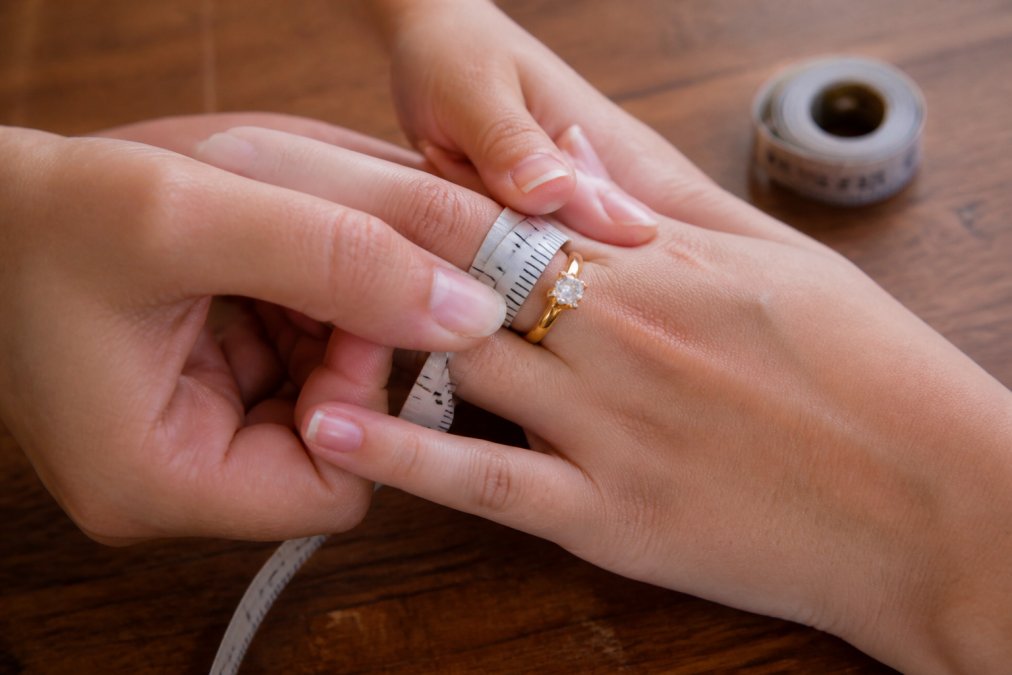
Close-up of a person's hand wearing a gold ring, with a soft measuring tape wrapped around the base of the finger to check ring size, natural daylight on a wooden table
Here's the sequence:
Australian ring sizes run alphabetically from A to Z, so convert your millimetre circumference against a jeweller's size chart rather than guessing. Width matters too: a 2mm band and a 6mm band in the same size feel completely different.
The best diamond shapes for short fingers are elongated cuts: oval, marquise, pear, and emerald. Each creates vertical lines that draw the eye up and down the finger, adding apparent length without adding carat weight.
Engagement ring styles for short fingers should keep the band slim and the setting high. A tapered band that narrows toward the centre stone pulls the eye inward and upward, while a plain 2mm band avoids cutting the finger visually in half.


Solitaire settings do this best: the centre stone sits exposed with no competing detail, so the eye travels straight up the finger. Halo settings work only when the halo is small and follows an elongated outline; a chunky round halo flattens the effect.
The best diamond cuts for slender fingers add visual width: round brilliant, cushion cut, and radiant cut. On a long, narrow finger, elongated shapes exaggerate the length and make the hand look stretched.
A round brilliant brings symmetry and maximum light return to a narrow finger. The cushion cut softens the outline with rounded edges while carrying weight across the finger. The radiant cut combines a rectangular outline with brilliant-style faceting, geometric structure without the sharp corners of a princess cut.
Balance is the goal. A 2mm tapered band under a round or cushion centre keeps proportion in check, so the ring looks intentional rather than undersized.
For wide fingers and prominent knuckles, look for shapes with substantial finger coverage and a setting high enough to clear the knuckle comfortably. A larger centre stone with a broad outline balances a wider finger better than a delicate stone that gets lost.
What most guides miss is band thickness. A 4mm or 5mm band on a wide finger looks proportionate; the same band on a slender finger looks heavy. Band width does as much work as the stone.
Shape is the outline; cut is how the stone handles light. A brilliant cut uses 57 or 58 facets arranged to maximise brilliance and fire, so it hides inclusions well and sparkles from every angle. Step cuts like the emerald use long, flat facets that create a hall-of-mirrors effect but reveal clarity flaws more openly. On the hand, a step cut's long unbroken lines read as vertical, while a brilliant cut's scattered light return reads as a bright, rounder mass.
Setting style changes the finger's apparent size. A high-set solitaire adds height and draws the eye up; a low-profile bezel sits flat and can make a finger look shorter. An east-west setting, where an elongated stone lies horizontally across the finger, adds width instead of length, useful on a long hand, counterproductive on a short one.
Band width does more work than most shoppers realise, and it's the easiest thing to change after the stone is chosen. A band creates a horizontal line across the finger: the wider that line, the more the finger is visually cut into segments and the shorter it appears. A narrow band leaves more uninterrupted finger visible on either side of the stone, which reads as length.
As a working rule, 2mm is often considered a practical minimum for a durable everyday band, 2-3mm a balanced range for shorter or average fingers, and 4mm and above as needing a longer finger or wider hand to carry it without looking heavy (gem.org.au).
Tapered versus uniform matters just as much:
Finger Type |
Best Shapes |
Why It Works |
Band Guidance |
|---|---|---|---|
Short fingers |
Oval, marquise, pear, emerald |
Vertical lines add length |
Slim, 2mm tapered |
Slender fingers |
Round, cushion, radiant |
Adds width and balance |
2-3mm, tapered |
Wide fingers |
Cushion, radiant, emerald |
Broad finger coverage |
4-5mm |
Prominent knuckles |
Cushion, round |
Rounded edges, high setting |
3-4mm, comfort fit |
Elongated shapes work hardest here. Marquise, pear, oval and emerald cuts draw the eye vertically along the finger, so a 1 carat oval typically reads longer than a 1 carat round. Keep the band slim, around 2mm, and avoid deep halos that widen the silhouette. A tapered or wishbone band adds another vertical line. If you want a round stone, a higher six-claw setting lifts it away from the finger and reduces the squatting effect.
Not on its own. A round brilliant is symmetrical, so it adds width as much as length. On a short finger it can make the hand look broader unless the setting does the work: a high claw setting, a slim 2mm band, or a round stone set in a twisted vine or split-shoulder design all create vertical movement. The DP Online 14ct Yellow Gold Titanium Steel Twisted Vine Ring uses exactly this trick, pairing a round brilliant centre with a twisting pavé band.
Longer fingers carry width well, so round, cushion, radiant and princess cuts look balanced rather than heavy. Shorter fingers need elongation, which points to marquise, oval, pear and emerald shapes. The measurement that matters is finger length, not overall hand size: a person can have a small hand with long fingers, or a large hand with short, wide fingers, and each needs a different shape.
Wrap a strip of paper or a soft tape around the base of the finger, snug but able to slide over the knuckle, then measure the length in millimetres and match it to a ring size chart. Measure at the end of the day when fingers are at their largest, and check the knuckle width too, because a ring must clear it. Fingers change size with temperature and season, so measure twice on different days before ordering.


 is here! Shop now, pay later in 4 easy installments