Your cart
Your cart is empty
Continue shoppingDrawer menu

Last Updated: August 29, 2026
Diamonds are one of the most coveted minerals on earth, and choosing the right one requires more than a quick scroll through a product page. At DP Online Syd, we've guided countless customers through this decision, from first-time buyers selecting a pendant to couples investing in a bridal set. This guide covers what diamonds actually are, how to read a grading report, which shapes suit which personalities, and what separates a good diamond from an exceptional one. We'll also show you where lab-grown stones fit into the picture, how to care for your pieces, and what post-purchase appraisal means for your investment.
Most buyers focus only on size. The real variables that determine beauty and value are far more nuanced, and understanding them will save you money and ensure you end up with a stone you'll love for decades.
A diamond is a naturally occurring mineral composed entirely of carbon atoms arranged in a cubic crystal structure, making it the hardest natural substance on the Mohs scale at 10 out of 10. That crystal lattice gives diamonds their extraordinary hardness and their ability to interact with light in a way no other gemstone can replicate.
Most natural diamonds formed between one and three billion years ago, deep within the earth's mantle under extreme heat and pressure. They reached the surface through volcanic pipes called kimberlite or were deposited in alluvial deposits by ancient rivers. The rarity of these geological conditions is why natural diamonds command their prices.
Pure diamonds are 100% carbon, but trace elements present during formation influence their colour. Nitrogen produces yellow or brown tints, while boron creates the rare blue hue seen in stones like the Hope Diamond. The cubic arrangement of carbon atoms creates a tetrahedral bond structure extraordinarily resistant to scratching, which is why diamonds are used in industrial cutting tools as well as fine jewellery.
According to Geoscience Australia's mineral resources overview, Australia has historically been a significant source of diamond production, particularly from the Argyle mine in Western Australia, which was famous for producing rare pink diamonds before its closure in 2020.
Three optical phenomena define a diamond's visual character. Brilliance is the white light reflected back to your eye from the stone's interior and surface. Fire refers to the dispersion of light into spectral colours, those rainbow flashes you see when a diamond catches the sun. Scintillation is the pattern of light and dark areas, the sparkle you observe when either the stone or the light source moves.
These effects are governed by the diamond's refractive index (approximately 2.42), the precision of its facets, and the geometry of its pavilion and table. A poorly cut diamond with excellent colour and clarity will still look dull. This is why cut is considered the most important of the 4 Cs.
The 4 Cs framework, developed and standardised by the Gemological Institute of America, is the universal language for describing diamond quality. Understanding each grade lets you make an informed comparison between stones and avoid paying for characteristics that don't meaningfully affect appearance.
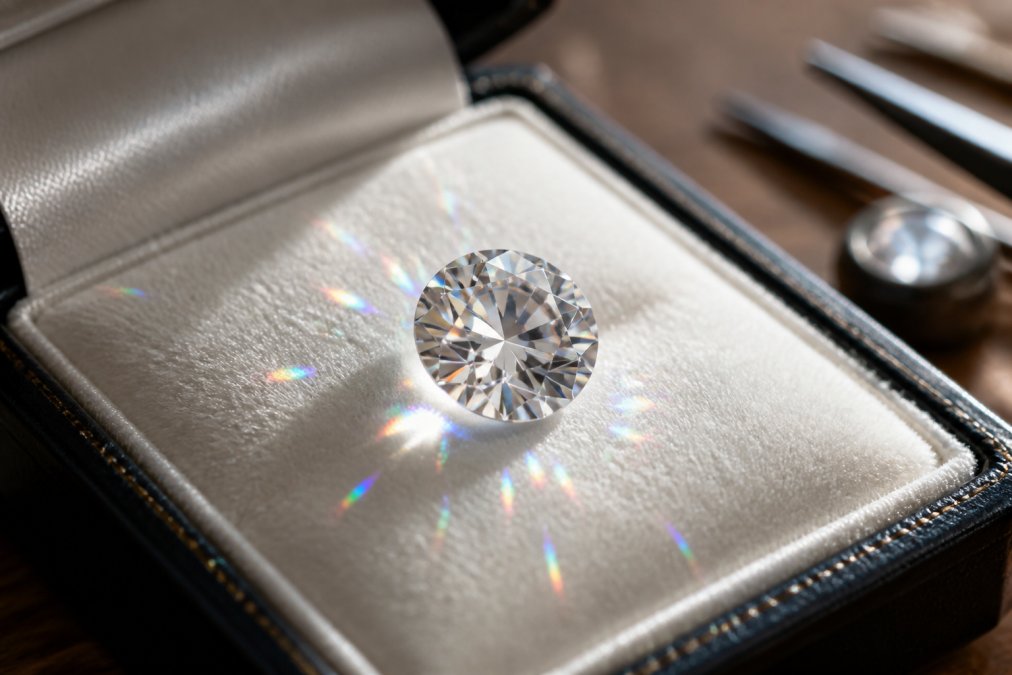
Cut grades range from Excellent to Poor and assess proportions, symmetry, and polish. An Excellent or Very Good cut maximises brilliance and fire. Cut is the one C you should never compromise on.
Colour is graded on a scale from D (colourless) to Z (light yellow or brown). The sweet spot for most buyers sits between G and I: stones that appear white to the naked eye but cost considerably less than D-F grades.
Clarity measures inclusions (internal characteristics) and blemishes (surface features). The scale runs from Flawless to I3. For most jewellery purposes, VS2 or SI1 stones are eye-clean, meaning inclusions are not visible without magnification.
Carat is a unit of weight, not size. One carat equals 0.2 grams. Two diamonds of equal carat weight can appear very different in size depending on their cut and shape.
| The 4 Cs | Grade Range | Buyer's Sweet Spot | Impact on Price |
|---|---|---|---|
| Cut | Excellent to Poor | Excellent or Very Good | Highest impact |
| Colour | D (colourless) to Z | G to I | High impact |
| Clarity | Flawless to I3 | VS2 to SI1 | Moderate impact |
| Carat | Weight in grams (0.2g = 1ct) | Varies by budget | Directly proportional |
GIA-certified diamonds come with a grading report issued by the Gemological Institute of America's diamond grading laboratory, the most trusted independent authority in the industry. The report documents every aspect of the stone: its measurements, cut grade, colour grade, clarity grade, carat weight, fluorescence, polish, and symmetry.
A GIA certificate is not a guarantee of beauty. It is a precise description of the stone's characteristics. Two GIA-certified diamonds with identical grades can still look very different depending on subtle cut proportions. Use the certificate as a foundation, then assess the stone visually or request high-resolution imagery when buying online.
The most common mistake buyers make is choosing a shape based on trend rather than lifestyle. A marquise diamond looks spectacular but its pointed ends are vulnerable to chipping. A round brilliant is the most forgiving shape for active wearers.
Round brilliant diamonds account for the majority of diamond jewellery sales globally. Their 58 facets are mathematically optimised for maximum brilliance and fire. Every other shape, collectively called fancy shapes, involves trade-offs between visual impact and light performance.
The setting amplifies or diminishes the shape's natural character. A solitaire setting in white gold or platinum lets the stone speak for itself. A halo setting of smaller diamonds surrounding the centre stone creates the illusion of greater size.
Most buyers ignore fluorescence, missing an opportunity. Fluorescence is the tendency of a diamond to emit a soft glow (usually blue) under ultraviolet light. In D-F colour stones, strong fluorescence can make a diamond appear hazy in sunlight. In G-I colour stones, faint to medium blue fluorescence often improves the stone's apparent whiteness and represents genuine value.
Polish and symmetry, both graded Excellent to Poor on a GIA report, describe the quality of the facet surfaces and the precision of their alignment. A diamond with Excellent cut, Excellent polish, and Excellent symmetry is sometimes called a "triple excellent" stone.
Lab-grown diamonds are physically, chemically, and optically identical to natural diamonds. Both are pure carbon in a cubic crystal structure. The only difference is origin: natural diamonds formed over billions of years in the earth's mantle, while lab-grown diamonds are created in weeks using High Pressure High Temperature or Chemical Vapour Deposition processes.
Lab-grown diamonds are graded using the same 4 Cs system and can carry GIA certification. They are conflict-free by definition and typically cost significantly less than natural stones of equivalent grade. Natural diamonds, on the other hand, retain value in a way lab-grown stones currently do not. The resale market for lab-grown diamonds is still maturing, and prices have fallen sharply as production has scaled.
For everyday jewellery and personal expression, lab-grown diamonds offer exceptional value. For engagement rings or pieces intended to be heirlooms, many buyers still prefer the irreplaceable geological story of a natural stone.
The right piece of diamond jewellery depends on the occasion, the wearer, and the budget. DP Online Syd offers a curated range of hallmarked 9ct gold diamond pieces that span gifting, everyday wear, and bridal milestones.

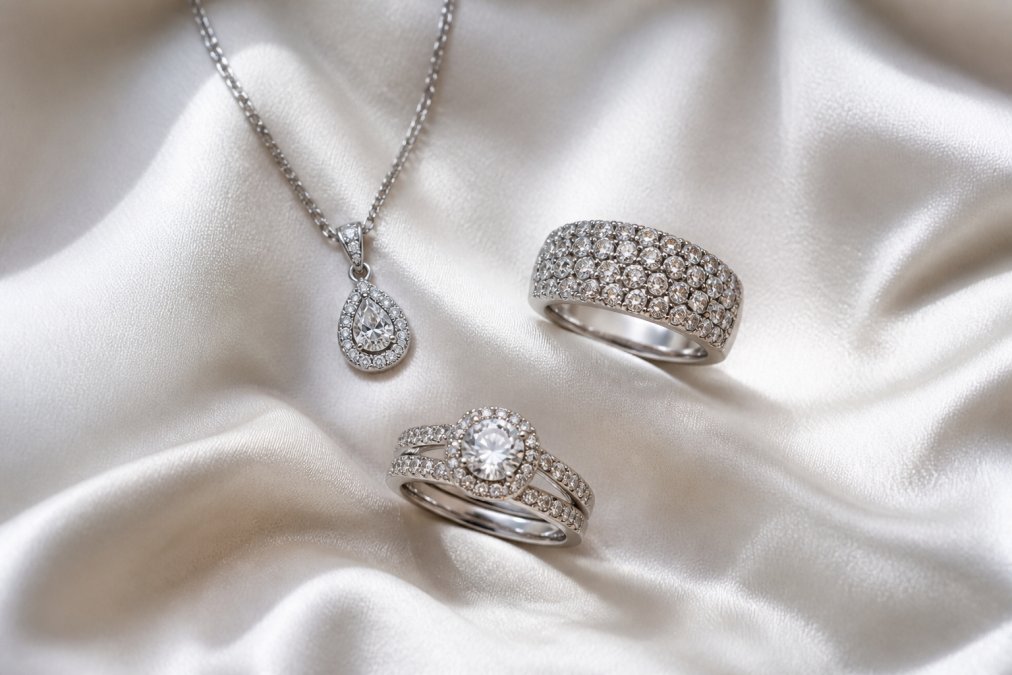
For those entering the world of diamond jewellery, a pendant is the most accessible starting point. The 9ct Yellow Gold Diamond Pendant Necklace features a flower cluster of brilliant white diamonds set in hallmarked 9ct yellow gold, priced at $149.93.
For something with more presence, the 9ct Gold Diamond Miracle Set Flower Cluster Pendant at $269.25 uses the miracle setting technique to maximise apparent stone size.

Dress rings sit at the intersection of everyday luxury and statement jewellery. The 9ct Yellow Gold 1/6 Ct Diamond Dress Ring, priced at $944.93, features 19 points of brilliant-cut diamonds in a pear-shaped halo design.

For bridal purposes, the 9ct Yellow Gold 1 Carat Diamond 2 Ring Bridal Set at $5,249.25 delivers one full carat of brilliant-cut diamonds across a vintage-inspired two-ring set in hallmarked 9ct yellow gold.
All pieces ship free on orders over $100 and are backed by a lifetime warranty.
Not every diamond is an investment. The investment-grade category is narrow: typically natural, certified stones of one carat or above, with colour grades of D-F, clarity of VS2 or better, and Excellent cut.
For most buyers, the more relevant concept is post-purchase appraisal. An independent appraisal, conducted by a qualified valuer, assigns a replacement value to your piece for insurance purposes. This is separate from the resale value, which is almost always lower.
According to the Jewellers Association of Australia's consumer guidance, having jewellery independently appraised within 12 months of purchase is considered best practice, particularly for pieces valued above $1,000. Keep the appraisal document alongside your purchase receipt and any GIA certificate.
Insurance for jewellery is available through most general insurers as a scheduled item under a home and contents policy. Confirm that the policy covers accidental loss and damage, not just theft.
Diamonds are extraordinarily hard, but the settings that hold them are not. Most diamond jewellery damage comes from impact, chemical exposure, or neglect of the metal rather than the stone itself.
Avoid wearing diamond jewellery during activities that expose it to chlorine, bleach, or harsh cleaning products. These chemicals do not damage the diamond but can degrade gold alloys and weaken prong settings over time, increasing the risk of stone loss.
Practical care guidelines for diamonds:
For hallmarked gold pieces, the gold itself requires no special treatment beyond avoiding abrasion. Sterling silver settings will tarnish over time and benefit from occasional polishing with a purpose-made silver cloth.
According to the Australian Competition and Consumer Commission's jewellery care guidance, consumers have rights under Australian Consumer Law if a piece fails due to a manufacturing defect, regardless of whether a separate warranty is offered.
Regular cleaning and annual professional checks will keep your diamond jewellery looking as brilliant in twenty years as it does today.
Choosing the right diamond piece involves more decisions than most buyers anticipate, from cut grades and fluorescence to setting styles, metal choices, and post-purchase appraisal. DP Online Syd simplifies that process with a curated range of hallmarked 9ct gold diamond jewellery, backed by a lifetime warranty, free shipping on orders over $100, and beautifully presented packaging for every order. Whether you're starting with a pendant or committing to a bridal set, shop now at dponlinesyd.com and find a piece crafted to last a lifetime.
A natural 1 carat diamond in Australia typically ranges from around $5,000 to $20,000 or more, depending on cut quality, colour grade, clarity and whether it carries GIA certification. Lab-grown diamonds of the same carat weight cost significantly less. For accessible entry points, diamond jewellery pieces such as cluster pendants and dress rings let you enjoy genuine diamonds at a fraction of that price.
The 4 Cs are cut, colour, clarity and carat weight. Cut determines how well the facets interact with light to produce brilliance and fire. Colour grades run from D (colourless) to Z (light yellow). Clarity measures internal inclusions and surface blemishes. Carat is the unit of weight, with one carat equalling 0.2 grams. GIA-certified diamonds carry a grading report confirming all four values independently.
Natural diamonds form deep in the earth over billions of years, brought to the surface through kimberlite pipes or alluvial deposits. Lab-grown diamonds are produced in controlled environments that replicate those high-pressure, high-temperature conditions. Both share identical chemical composition, crystal structure and hardness on the Mohs scale. The key differences are origin, price and resale behaviour, natural stones generally hold value better over time.
Ask for documentation. Reputable retailers source conflict-free diamonds that comply with the Kimberley Process Certification Scheme, an international framework that tracks rough diamonds from mine to market. GIA-certified loose diamonds include provenance information in their grading reports. When buying jewellery, look for retailers who are transparent about their supply chain and can confirm their stones are conflict-free in writing.
This article was written using GrandRanker


 is here! Shop now, pay later in 4 easy installments