Your cart
Your cart is empty
Continue shoppingDrawer menu

Last Updated: September 24, 2026
The crystal market is flooded with fakes, glass imitations, heat-treated stones, and synthetically dyed crystals sold as authentic. Learning to identify authentic healing crystals protects both your wallet and your trust.
You don't need expensive equipment or a gemologist to spot fakes. A few simple tests reveal whether a crystal is genuine.
Natural crystals have unique inclusions, fractures, and colour variations; synthetic or imitation stones are uniform by design. Understanding these differences helps you make informed choices.
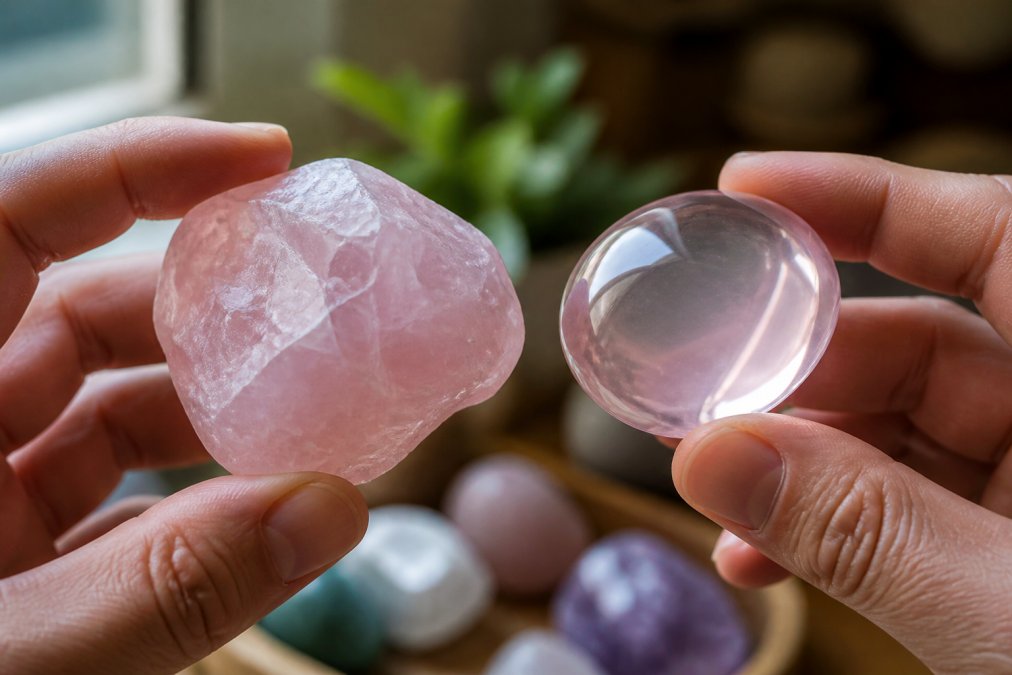
Glass is manufactured to be uniform and smooth; real crystals have natural variations that glass cannot replicate.
Pick up the stone. Does it feel substantial in your hand?
Real crystals are denser than glass because they have a crystalline structure with tightly packed molecules, while glass is amorphous with randomly arranged, less compact molecules.
Hold the stone in one palm and compare it mentally to glass of the same size, authentic crystals feel heavier for their volume. You can also weigh stones on a kitchen scale to compare identical sizes.
Touch the crystal to your cheek or forehead.
Real crystals stay cool longer than glass because they conduct heat away from your skin more efficiently; glass warms up quickly.
Place the stone against your skin: glass warms up within 10-15 seconds; authentic crystals remain cool for 20-30 seconds or longer. Test in room-temperature environments, avoiding stones in direct sunlight.
Using a jeweller's loupe (10× magnification):
A jeweller's loupe reveals: natural scratches in random patterns (glass shows uniform polish marks), micro-facets and uneven surfaces (glass is uniformly smooth), tiny inclusions trapped inside (glass has none), and striations or growth lines (glass has no structure).
Using a smartphone macro lens (no equipment needed):
Use your smartphone's macro lens or a free macro app to photograph the stone in natural daylight. Compare your photo to reference images online: authentic stones show complexity; glass appears featureless. This free, non-destructive method works before purchase or for verification.
Watch for: uniform colour (glass is dyed uniformly; real crystals show variation), surface bubbles (hallmark of glass), and seams or mould lines (glass edges are too uniform; real crystals have irregular edges).
Some fakes are real crystals artificially altered through heat treatment or synthetic dyeing. These change the stone's energetic properties and may fade over time.
Natural Rose Quartz Crystal Palm Stone →
Examine the colour distribution carefully.
Natural crystals show organic colour zoning with subtle transitions following growth patterns. Heat-treated stones show sharp, uniform colour changes. Synthetically dyed crystals have unnatural saturation that looks painted on, while real crystals have depth throughout their structure.
A blacklight test reveals dyes and treatments.
Under UV light, heat-treated and dyed stones fluoresce differently than natural specimens. If you have access to a blacklight, compare the glow to reference images online, unusual fluorescence suggests treatment.
The Mohs hardness scale reveals whether you're holding a genuine crystal or an imitation. Treatment doesn't change hardness, only colour.
The Mohs scale ranks minerals 1-10 (talc to diamond). Each mineral scratches everything below it and is scratched by everything above it, allowing non-destructive authenticity testing.
Most healing crystals (rose quartz, amethyst, clear quartz, citrine) rank 7 on the Mohs scale. Glass ranks 5.5-6.5, making genuine quartz-based crystals harder than glass.
Gently try to scratch the crystal with a piece of glass: if the crystal scratches the glass, it's likely genuine quartz; if glass scratches the crystal, it's probably glass.
Real crystals contain inclusions (tiny particles trapped during formation) and natural fractures, proof of authenticity. Glass has no inclusions; synthetic crystals have fewer than natural stones.
Some crystals are faked far more often than others because they're popular, expensive, or easy to imitate. Here's how to spot the most common counterfeits:
Citrine vs. Heat-Treated Amethyst
Rose Quartz: Dyed Glass vs. Natural
Amethyst: Synthetic vs. Natural
Turquoise: Dyed Howlite vs. Natural
How to tell the difference:
Natural Rose Quartz Crystal Palm Stone →
Clear Quartz: Synthetic vs. Natural
How to tell the difference:
Red Jasper: Dyed vs. Natural
How to tell the difference:
Authenticity and ethics go hand in hand. An authentic crystal sourced unethically is still a problem. Ethical sourcing means the crystal was mined and processed responsibly, without exploitation or environmental damage.
When shopping for healing crystals, ask retailers these questions:
You don't need a lab to verify authenticity. These simple tests use items you already have.
Tap the crystal gently with another stone or a wooden utensil.
The test is quick:
Hold the crystal up to light and observe how light passes through it.
Here's what to observe:
Identifying authentic healing crystals is a skill you can develop with just a few simple tests. Weight, temperature, hardness, and visual inspection reveal the truth about what you're buying. Natural crystals have unique characteristics that glass and synthetic alternatives cannot replicate.
Real crystals have consistent weight and density that matches their mineralogy, feel cool to the touch longer than glass, and show natural inclusions or fractures. Fake crystals made from glass or resin feel lighter, warm up quickly in your hand, and appear too perfect with uniform colour. Check for air bubbles (indicates glass), test hardness with a fingernail (real crystals resist scratching), and examine under magnification for the crystalline structure unique to authentic stones. Authentic healing crystals from ethical suppliers like DP Online Syd come with transparency about sourcing and treatment.
Glass imitations are the most common fake. Look for uniform bubbles trapped inside, perfectly smooth surfaces with no natural variation, and a glassy lustre rather than the natural lustre of genuine stone. Plastic counterfeits feel too light and warm quickly. Dyed stones show unnaturally bright colour with sharp boundaries, while heat-treated stones display obvious colour zoning where one area is intensely coloured and another is nearly colourless. Real crystals show gradual colour transitions and natural inclusions. If a price seems far too low for a large piece, it's likely not authentic.
Genuine crystals have higher thermal conductivity and remain cool to the touch longer than glass or plastic. Hold a stone against your cheek for 10 seconds, then compare it to a known glass object. Real crystals feel noticeably cooler. Weight is equally important: authentic stones are denser than glass or resin of the same size. A rose quartz palm stone should feel substantial and grounded in your hand. Check the weight specification (our Natural Rose Quartz Crystal Palm Stone weighs 185.3g) and compare it to what you hold. Light, hollow, or suspiciously cheap pieces often contain synthetic materials or glass.
Seek retailers who disclose treatment, origin, and weight transparently. Authentic suppliers like DP Online Syd specify whether stones are hand-polished, untreated, or heat-treated, and note natural features like inclusions or fractures as authenticity markers, not flaws. Verify that product descriptions match photographs and include dimensions and weight. Check for ethical sourcing statements and warranties. Avoid sellers claiming vague metaphysical benefits without acknowledging that beliefs vary. Read reviews about delivery condition and accuracy to photos. Premium pricing often reflects genuine sourcing and craftsmanship, but transparency matters more than price alone.


 is here! Shop now, pay later in 4 easy installments