Your cart
Your cart is empty
Continue shoppingDrawer menu

Last Updated: September 14, 2026
Standard home and contents policies treat diamond jewellery as generic personal property, which is why learning how to insure your diamond jewellery properly matters more than most owners realise. Customers often assume their existing cover handles a lost or damaged diamond, only to find the payout falls short of replacement cost.
The reason is valuation. A policy might list "jewellery" with a blanket limit, but a single diamond ring or tennis bracelet can exceed it. Without a current valuation certificate and a specified listing, you rely on the insurer's discretion at claim time.

This guide covers valuation requirements, bundled versus standalone cover, policy limits, documentation, and how a claim works.
A jewellery valuation certificate is a formal document from a qualified valuer stating what your piece is worth for insurance purposes, based on a physical inspection. Insurers generally require it above a certain value, and will ask for a fresh one once the certificate ages out.
Most insurers also want the valuation to be recent. An Australian Securities and Investments Commission guide to insurance explains that underinsurance is one of the most common reasons claims fall short, and outdated valuations are a leading cause. The practical consequence is that a certificate is not a one-off purchase, it is a document with a shelf life.
Use a valuer independent of the retailer that sold you the piece, holding a recognised qualification. Insurers look for members of a professional body such as the National Council of Jewellery Valuers (NCJV), which requires a code of conduct and ongoing testing (Code of Ethics). A valuation from the selling shop is not automatically rejected, but carries less weight if the figure is disputed.
Ask whether the valuer inspects the stone loose or in the setting. An in-setting assessment is acceptable for insurance, but a loose-stone assessment gives more precise grading. If your piece has a GIA or IGI certificate, bring it, the valuer will cross-check the grading.
A usable certificate should show the item description, metal type and purity, stone details, measurements, and the replacement figure. Insurers routinely reject certificates that omit any of the following:
Revalue every two to three years, or sooner if you buy, sell, or inherit a significant piece. Insurers commonly ask for an updated valuation at renewal, and resizing or repair should also trigger a revaluation.
Beyond the calendar, there are specific triggers that should prompt an early revaluation:
Diarise a revaluation two years from the certificate date and review the figure at every renewal. If the replacement value has moved materially, update the specified value before the next premium is calculated.
Keep the previous certificate when you revalue. If a claim is disputed, a history of valuations showing a consistent, professionally assessed figure strengthens your position considerably.
Bundled cover suits lower-value pieces; standalone jewellery insurance fits anything you would struggle to replace out of pocket. The choice depends on your collection's total value and how much control you want over the terms.
If your diamond pieces sit under your policy's jewellery sub-limit and you own only one or two items, adding them to home contents is simple and often cheaper. You still need a valuation and a specified listing above the sub-limit.
A standalone policy is worth it when your collection is valuable, you travel with your jewellery, or you want accidental damage and loss cover away from home. Standalone cover typically offers higher limits and clearer terms for specified items.
| Feature | Bundled Home Contents | Standalone Jewellery Policy |
|---|---|---|
| Best for | One or two lower-value pieces | Valuable or multiple pieces |
| Limits | Shared sub-limit | Higher, item-specific |
| Travel cover | Often limited or excluded | Usually included |
| Valuation needed | Above sub-limit | Almost always |
Specified items are individual pieces listed on your policy with their own agreed value, rather than left inside a general category. This is the most important step for insuring a high-value diamond piece, because it removes the ambiguity that causes claim disputes.
A policy limit is the maximum the insurer will pay in total; a sub-limit is a smaller cap inside that total, usually applied to categories like jewellery. If your diamond ring exceeds the jewellery sub-limit and is not specified, the insurer may only pay up to the sub-limit.
Ask your insurer to confirm the specified value in writing before you pay the premium. If the figure on the schedule does not match your valuation certificate, fix it then, not after a loss.
Photograph every piece, keep digital copies of valuation certificates, and store originals separately from the jewellery. This record turns a stressful claim into a straightforward one.
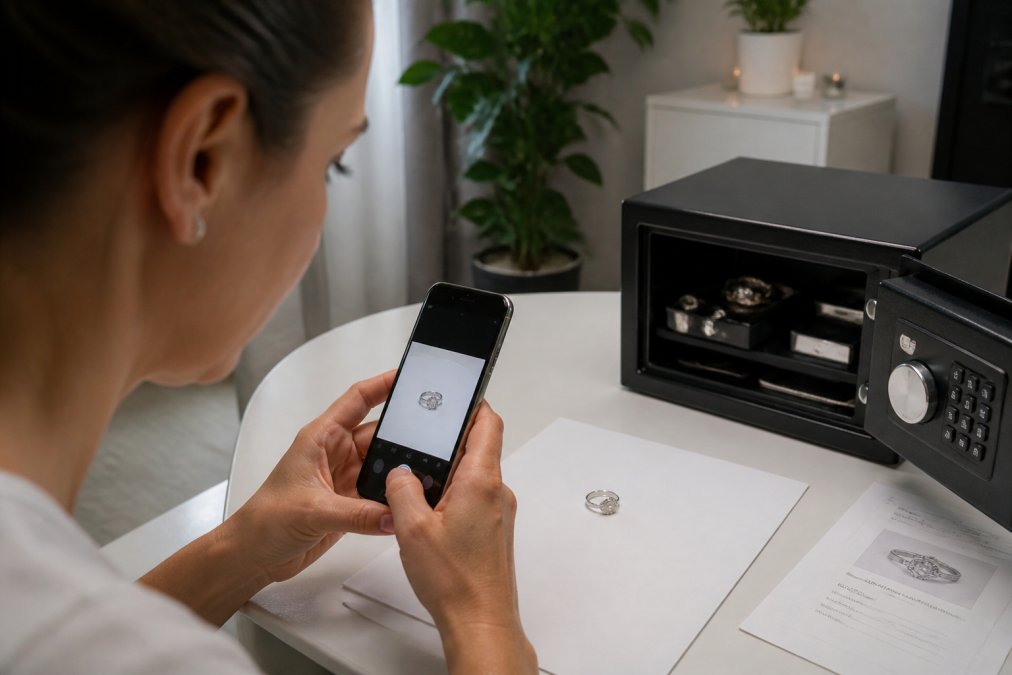
A practical system looks like this:
For pieces like our 9ct Yellow Gold 1 Carat Diamond 17.5cm Tennis Bracelet, a clear photo of the hallmark and stone settings makes the claim far easier to process.
Report the loss or damage to your insurer as soon as possible, then supply the documents they request. Speed and completeness keep a claim moving.
The usual steps:
Keep copies of everything you send. If the insurer offers a replacement rather than cash, check that the replacement matches the agreed value and specifications on your certificate.
Travel and rising prices are the two areas where jewellery cover most often falls short, and both are easy to address in advance. The way insurers treat jewellery away from home is where the real gaps sit.
A standard home contents policy is written around a fixed address. Cover for items temporarily removed is usually provided, but narrower than cover at home. The three limits to look for are:
If your diamond ring exceeds the off-premises cap and is not specified, the insurer may pay only up to that cap, regardless of the ring's actual worth. Specifying the item usually lifts it out of the general off-premises limit, though it may still carry travel conditions.
A common pattern is for travellers to assume their home contents policy follows them anywhere in the world. Many do not, and those that do often cap the cover at a figure well below the value of a single diamond piece. Confirm the position before you leave, not after.
Diamond and precious metal prices shift over time, so a valuation from several years ago may no longer reflect replacement cost. A diamond piece is replaced by buying an equivalent stone and setting at today's market, a figure that can move either way.
Two forces drive the change:
The risk is underinsurance. If your specified value is below the true replacement cost, the insurer may apply averaging, paying a proportion of the claim rather than the full amount, and you cover the shortfall yourself (afca.org.au).
Build a revaluation reminder into your calendar every two to three years and review specified values at each renewal. A workable cycle:
Treat jewellery cover as a cycle, not a one-off task: value it, specify it, document it, and revalue it on a schedule. The pieces most likely to cause a claim dispute are the ones whose valuation has quietly fallen behind the market.
Getting the cover right is a habit, not a one-off task: a current valuation, a specified listing, and a documented record protect you when something goes wrong.
At DP Online Syd, every piece comes with a lifetime warranty and is delivered in beautiful packaging, with free shipping on orders over $100. Explore our diamond dress rings and hallmarked gold and sterling silver collections, then insure them properly from day one. Shop now and give your jewellery the protection it deserves.

Premiums vary by insurer, location and claims history, but a common benchmark is roughly $1 to $2 per $100 of insured value per year. For a $10,000 ring, that works out to about $100 to $200 annually. If the ring is listed as a specified item on a home and contents policy, you may also pay a higher excess on jewellery claims. Always get a current valuation certificate first, because insurers base the premium on the documented replacement value, not what you originally paid.
Most home and contents policies include some cover for jewellery as part of your general contents, but strict sub-limits usually apply. A typical policy might cap unspecified jewellery at a few thousand dollars per item, which is rarely enough for a diamond ring. To insure diamond jewellery properly, you generally need to list each piece as a specified item with a current valuation, or take out a standalone jewellery policy that covers accidental damage, loss and theft without the contents sub-limit.
You will need a recent jewellery valuation certificate from a qualified valuer, which should describe each piece in detail: metal type and purity, stone weight and quality, setting style and replacement value. Keep the original purchase receipt and any diamond certificate or gemological report, as these support the valuation. Photographs of the piece from multiple angles, including close-ups of hallmarks and settings, are also useful. Store digital copies in cloud storage so you can access them quickly if you need to make a claim.
It depends on how easily you could replace it. If losing the ring would be a significant financial hit, insuring it is usually worthwhile. At roughly $1 to $2 per $100 of value, a $3,000 ring might cost $30 to $60 a year to cover, which is a small price for peace of mind. If the ring is a lower-value everyday piece and you could comfortably replace it, you might choose to self-insure. Pieces like the 9ct yellow gold 18cm diamond bracelet at $699 are often good candidates for self-insuring, while higher-value items like the 9ct yellow gold 1 carat tennis bracelet at $3,999 are better specified on a policy.


 is here! Shop now, pay later in 4 easy installments