Your cart
Your cart is empty
Continue shoppingDrawer menu

Last Updated: September 15, 2026
Tarnish on a gold necklace is a surface reaction, not a sign that the metal has failed. Understanding what causes it, and what your necklace is actually made of, tells you which cleaning method is safe before you touch it.
Gold itself does not tarnish. What you see on a dull chain is usually oxidation of the alloyed metals mixed into the gold, or a reaction with sulphur compounds in the air, cosmetics and skin oils. This guide from DP Online Syd walks through the safest way to remove tarnish from gold necklaces at home, and when to stop and hand the piece to a professional.

Here's what most care guides skip: the method that rescues a solid gold chain can permanently strip a plated one. Below, we'll show you exactly how to tell the difference before you clean anything.
Tarnish is the oxidation and sulphurisation of the non-gold metals in an alloy. Pure gold is chemically inert, so it resists corrosion (pubmed.ncbi.nlm.nih.gov). Copper, silver and zinc, which are commonly added to gold to give it strength and colour, are not.
When those metals meet sulphur compounds in the air, in perfume, in hair products or on your skin, they form a dark surface layer. Chlorine and household cleaning products accelerate the reaction. The result is dullness, a grey or brownish film, and a loss of luster that no amount of wiping will fix.
Solid gold is gold all the way through. Gold-plated jewellery is a base metal, often brass or copper, with a thin layer of gold bonded to the surface. The karat stamp tells you the alloy's gold content: 9K, 14K and 18K are the common marks on solid pieces.
That distinction decides your cleaning method. Solid gold can handle gentle soaking, mild detergent and careful brushing. Gold-plated pieces cannot. Abrasive rubbing, long soaks and polishing compounds wear through the plating and expose the base metal, which tarnishes fast and cannot be polished back.
Check the hallmark or stamp before you clean. If there is no karat mark and the piece was inexpensive, treat it as plated.
Gather these before you start, so you are not improvising mid-clean:
Skip paper towels, which scratch. Skip anything labelled abrasive. And skip the ultrasonic cleaner unless you know exactly what stones are set in the piece, which we cover below.
The mild dish soap method is the safest starting point for solid gold. It lifts surface oils and light oxidation without attacking the metal or the settings.
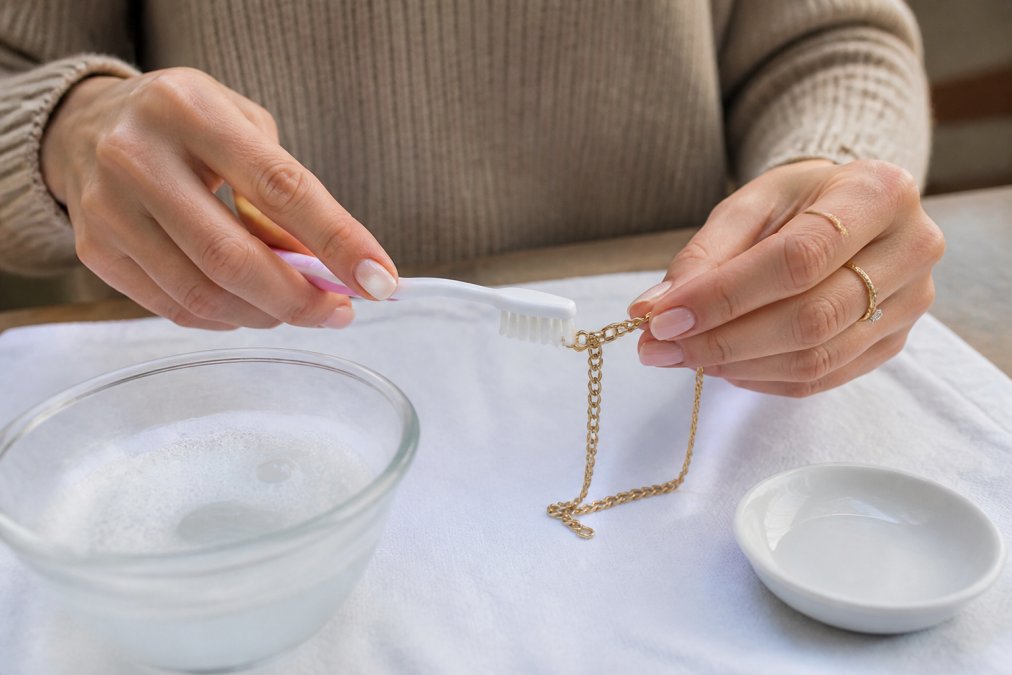
Expect light tarnish to lift on the first pass. Heavier buildup may need a second soak, but repeated scrubbing does more harm than good.
Vinegar and baking soda are popular home remedies, and for solid gold with no stones they can work. For most necklaces, they are the wrong tool.
Both are mildly abrasive or acidic. On gold-plated jewellery, they strip the plating. On pieces with gemstone settings, they can damage porous or sensitive stones. Soft stones such as opal, pearl, turquoise and emerald are particularly vulnerable to acids (Analysis of Gemstones at GIA Laboratories). Ammonia-based cleaners carry the same risk.
If you are unsure what the stones are, do not use either. The mild detergent method is slower but will not cost you the piece.
Gold-plated jewellery needs a gentler routine: no soaking, no brushing, no polishing compounds.
Wipe plated pieces with a soft, slightly damp cloth, then dry immediately with a microfibre cloth. That is the whole method. Anything more aggressive removes the gold layer that gives the piece its colour, and once the plating is gone, no cleaner brings it back.
For plated chains, prevention matters more than cleaning. Keep them away from perfume, hairspray and chlorine, and store them separately so they are not rubbed by harder metals.
For everyday maintenance, a dedicated jewellery cleaner beats DIY mixtures because it is formulated for the metal and leaves no residue behind.
The best gold jewellery cleaning solution is one matched to your piece: a mild ammonia-free liquid or spray for solid gold, and a soft polishing cloth for plated jewellery and delicate settings. Household alternatives work in a pinch, but they carry risk that a purpose-made product does not.
DP Online Syd stocks a few options that cover both cases. The All-in-One Jewellery Polish & Protection Solution is a spray formulated for pure gold, silver, platinum and fine jewellery, and it cleans and protects in one step. For a deeper clean on solid pieces, the 5 Pack DP Online Cleaning Effervescent Tablets dissolve in water and lift oxidation without scrubbing. For daily touch-ups, a Quality Microfibre Suede Cleaning Cloth lifts fingerprints and surface oils without scratching.


| Solution | Best For | Method | Watch Out For |
|---|---|---|---|
| Mild dish soap | Solid gold, no fragile stones | Soak, brush, rinse, buff | Not for plated pieces |
| Ammonia-free spray | Solid gold, daily upkeep | Spray, wipe, buff | Read the label for ammonia |
| Effervescent tablets | Solid gold with heavy tarnish | Drop, dissolve, soak, rinse | Skip on plated and porous stones |
| Microfibre cloth | All jewellery, daily shine | Dry buff only | Will not remove heavy tarnish |
| Vinegar or baking soda | Solid gold, no stones | Paste or soak | Damages plating and soft stones |
An ultrasonic cleaner uses high-frequency vibration to lift dirt from crevices. It is excellent for solid gold with hard, well-set stones, and it reaches places a toothbrush cannot.
It is also the fastest way to destroy a piece. Ultrasonic vibration can loosen stones in weak settings and is unsafe for emerald, opal, pearl and other fragile stones (Ultrasonic Cleaners for Gems: What You Need to Know). It should never be used on gold-plated jewellery. If you own one, use it only on solid gold with hard stones and settings you know are secure.
Prevention is cheaper than cleaning, and it takes about ten seconds a day. The goal is to keep sulphur compounds, moisture and abrasion away from the alloyed metals in the gold, because those are what drive the surface reaction.
Yes, tarnish on gold is a surface reaction that can be reversed. For solid gold, a mild soapy solution and a soft-bristled toothbrush will lift oxidation without harming the metal. Gold-plated pieces need a gentler approach because abrasive methods can wear away the plating. A microfibre polishing cloth or a non-abrasive jewellery polish spray can restore shine safely.
White vinegar can remove tarnish from solid gold, but it is acidic and may damage gold-plated jewellery or certain gemstones. For plated pieces, skip vinegar entirely. If you use it on solid gold, dilute it with lukewarm water, soak briefly, and rinse thoroughly. A mild detergent solution is safer for regular cleaning and works well for most gold necklaces.
Baking soda is a mild abrasive that can scratch gold, especially plated jewellery. It is not recommended for routine cleaning. For solid gold with heavy tarnish, a paste of baking soda and water applied with a soft cloth may help, but you risk dulling the finish. A non-abrasive jewellery cleaner or professional ultrasonic cleaning is a safer choice.
Clean your gold necklace every two to four weeks if you wear it daily. Oils, sweat, and cosmetics build up and dull the surface. A quick wipe with a microfibre cloth after each wear helps maintain luster. Deep clean with a mild soapy solution monthly. Store pieces separately in a dry pouch to slow oxidation and prevent scratches.


 is here! Shop now, pay later in 4 easy installments