Your cart
Your cart is empty
Continue shoppingDrawer menu

Last Updated: September 10, 2026
Learning how to store crystals to maintain energy starts with understanding that a crystal is doing two jobs at once: holding a physical structure and holding a vibrational signature. Both can degrade, and both degrade faster when storage is an afterthought. This guide from DP Online Syd covers the mineralogical side and the energetic side together, because treating them separately is where most collections quietly lose their lustre.
Here's the tension most guides skip: the two goals sometimes pull in opposite directions. A crystal you seal away from all light and handling keeps its surface pristine but can feel energetically flat when you return to it. A crystal left out on a sunny windowsill stays charged but fades and abrades. Good storage is a negotiation between those forces.
Hardness determines what a crystal can survive sitting next to. On the Mohs hardness scale, diamond sits at 10 and talc at 1, and the gap between a quartz point and a soft mineral like selenite is enormous (britannica.com). Store them loose in the same container and the harder stone wins every time, scratching and abrading the softer one.
Fragility matters separately from hardness. A stone can be hard and still chip along a cleavage plane, and thin points snap under pressure from other pieces stacked on top.
Many practitioners hold that crystals absorb and hold vibrational energy from their surroundings, which is why a piece can feel heavy or dull after a difficult week. The same logic says a crystal left in a cluttered, high-traffic spot takes on that noise. Energy depletion is not measurable in a lab, but the practical response is the same either way: cleanse, rest, and store with intention rather than leaving pieces scattered.
Cleanse a crystal before it goes into storage, not after, so it rests clean rather than holding whatever it picked up. The method depends on the stone. Water-safe minerals like quartz and amethyst can be rinsed briefly and patted dry. Soft, water-soluble minerals such as selenite should never touch water; use sound, smoke, or moonlight instead.
A simple sequence works for most collections:
The drying step is the one people skip. Trapped moisture is the fastest route to oxidation and surface damage.
Charging under moonlight is the gentlest way to restore a crystal without risking the fading that direct sunlight causes. The reason is mineralogical, not just traditional: ultraviolet radiation in direct sun breaks down the colour centres in amethyst, rose quartz, citrine and smoky quartz, and the change is cumulative and irreversible (gia.edu). Moonlight carries negligible UV, so it refreshes the piece energetically without touching the surface chemistry.
Place pieces on a windowsill or outdoor ledge during a full moon, ideally for one night, and bring them in before morning dew settles. Indirect light through glass is enough; you are not trying to bake the stone. The dew point matters more than most guides admit. Selenite, halite and other water-soluble minerals will begin to dissolve or craze if left out overnight in humid air, and even quartz can develop water spotting on a polished face (mindat.org). If you live in a humid climate, charge indoors on a dry sill rather than outside.
A practical monthly cycle looks like this:
Quartz, amethyst and moonstone all respond well to this method. Softer or water-soluble minerals such as selenite, halite and malachite should be charged indoors, away from any window that gathers condensation. If you keep a crystal grid, charge the individual pieces before assembling the grid rather than charging the finished arrangement, so each stone carries its own charge into the pattern.
A common pattern among collectors is to alternate methods: moonlight for the pieces you display and handle often, sound or smoke for the pieces you store long-term. The two approaches do different jobs. Moonlight restores a working crystal you use regularly; sound and smoke clear a piece before it goes into storage, where it may sit for months.
The best storage containers are wooden boxes lined with soft fabric, individual velvet pouches, and compartmentalised trays. Wood regulates humidity better than plastic, velvet and felt cushion against abrasion, and separate compartments stop hard and soft stones from grinding against each other.
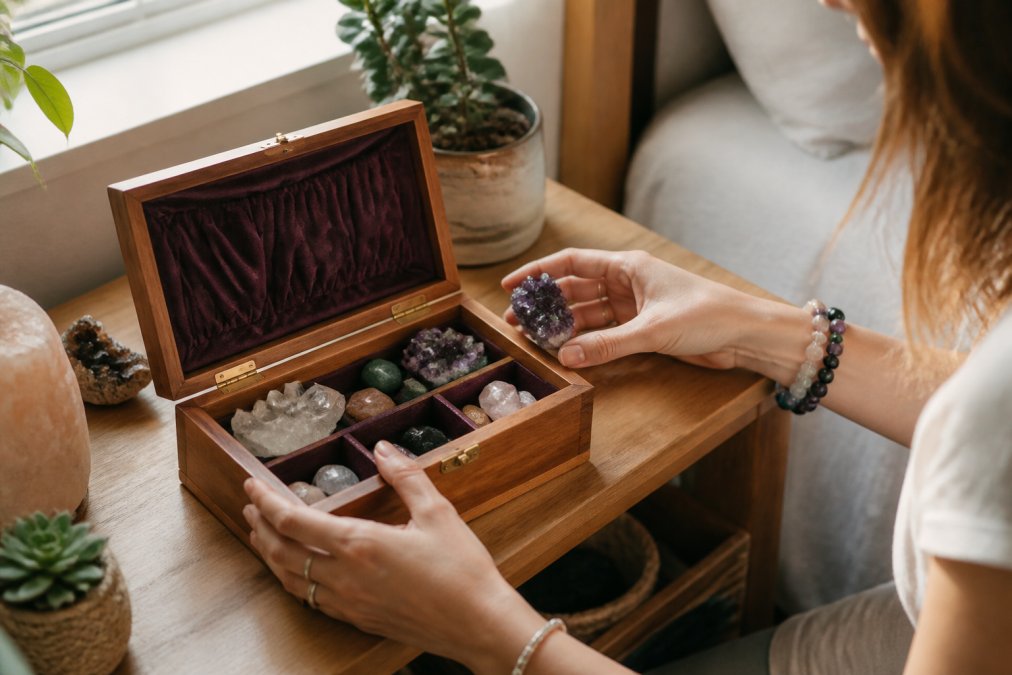
Avoid airtight plastic tubs for long-term storage. They trap any residual moisture and can encourage oxidation on metallic inclusions. Glass display cabinets work well for pieces you want visible, provided they sit out of direct sunlight.
Velvet pouches are the practical default for travel and for individual pieces. Wooden trays suit a display shelf where you want pieces visible but separated. Silk and cotton wraps are fine for short-term storage but compress over time and offer less cushioning than velvet. The rule of thumb: the softer the mineral, the softer the lining it needs.
Store crystals separately when their hardness differs by more than two points on the Mohs scale. Quartz at 7 will scratch calcite at 3, and repeated contact does the damage slowly enough that you may not notice until the surface is marked.
Grouping by family works well. Quartz varieties can share a tray. Softer minerals get their own pouch. Selenite, which is both soft and water-soluble, should always be stored alone.
A quick sort by hardness prevents most accidental damage:
| Hardness Band | Example Minerals | Store With | Store Away From |
|---|---|---|---|
| 7-10 (hard) | Quartz, amethyst, citrine | Other hard stones | Soft minerals, delicate points |
| 4-6 (medium) | Fluorite, apophyllite | Similar hardness | Quartz, harder specimens |
| 1-3 (soft) | Selenite, calcite, malachite | Individual pouches only | Everything harder |
Humidity and direct sunlight are the two environmental threats that do the most damage over time. Amethyst, rose quartz, and citrine all fade in prolonged direct sunlight, and the change is gradual enough that you rarely notice it happening. Store display pieces in indirect light, and rotate anything on a sunny sill.
Moisture drives oxidation on metallic inclusions and can cloud some minerals. Keep storage in a dry room, away from bathrooms and kitchens, and add a small silica packet to wooden boxes in humid climates. Handle crystals with clean, dry hands; skin oils dull a polished surface faster than most people expect.
Travel storage is where most collections take their worst knocks. A padded roll or hard-shell case with individual velvet slots protects pieces in transit far better than a shared pouch. Wrap fragile points in a soft cloth before they go in, and never pack crystals loose beside metal jewellery, which scratches them.
For rare or high-value mineral specimens, climate-controlled storage is worth considering. A cabinet held at stable temperature and moderate humidity protects pieces that are sensitive to swings. This is the scientific-versus-energetic split in practice: a museum-grade specimen may need archival conditions, while a working crystal you handle daily needs accessibility more than perfect climate control. Match the storage to the piece's role.
A dedicated sacred space does two things: it keeps crystals organised, and it gives them a consistent environment rather than a spot on a crowded shelf. The gap most guides miss is that a sacred space is also a micro-climate. Where you put it determines how much UV, humidity and temperature swing your collection experiences, and those three factors do more long-term damage than handling ever will.
Choose a surface away from direct sunlight and heavy foot traffic. A bedside table, a shelf in a quiet room, or a purpose-built altar all work. The practical test is simple: if the spot receives direct sun at any point in the day, it is a display spot, not a storage spot. Amethyst, rose quartz and citrine will fade there over months, and the change is gradual enough that you rarely notice it happening.
Layer the space so display and storage coexist, and match the layer to the piece's role:
| Layer | Purpose | Best For | Watch Out For |
|---|---|---|---|
| Open wooden tray | Daily handling and display | Quartz, amethyst, working pieces | Direct sun, dust, knocks |
| Closed wooden box | Long-term storage | Soft minerals, fragile points | Trapped moisture if not ventilated |
| Individual velvet pouch | Isolation and travel | Selenite, calcite, malachite | Compression over time |
| Glass cabinet | Visible display | Polished specimens, grids | UV through glass, heat build-up |
Keep the pieces you use most on open wooden trays, and store the rest in closed boxes beneath or beside them. Add a selenite plate or a small crystal grid to anchor the arrangement. Grouping by intention, grounding stones low and higher-vibration pieces above, keeps the space readable and easy to maintain.
This is where the scientific-versus-energetic split becomes practical. A museum-grade or high-value specimen benefits from archival conditions: stable temperature, moderate humidity, minimal light, and no handling. A working crystal you carry daily needs accessibility more than perfect climate control, and over-protecting it just means you never use it. Match the storage to the piece's role rather than applying one rule to the whole collection.
A few concrete habits keep the space working:
If you would rather not build the collection from scratch, DP Online Syd stocks handcrafted crystal pieces including the Handcrafted Chakra Crystal Stone Resin Pyramid, which combines amethyst, black obsidian, and a full chakra disc in a single piece, and the Handcrafted Quartz Stress Reduction Crystal Stone Resin Pyramid, built around a copper coil and orbital rings. Both arrive ready to display.


Store crystals in a cool, dark place away from direct sunlight. Use velvet pouches, wooden trays or fabric-lined boxes to prevent scratches and abrasion. Keep harder stones like quartz separate from softer ones such as selenite or malachite to avoid physical damage. For energetic preservation, cleanse them regularly and recharge under moonlight before returning them to storage. A dedicated shelf or drawer works well, as long as humidity stays low and each piece has its own space.
Not total darkness, but indirect light is best. Prolonged direct sunlight can fade colours in amethyst, rose quartz and citrine, and some stones like selenite can become brittle over time. A shaded shelf or a closed storage box protects both appearance and vibrational energy. If you display crystals, rotate them away from windows every few weeks and cleanse them to clear absorbed environmental energy.
Cleanse crystals before storage using moonlight, sound or selenite plates. Place a small selenite piece inside the storage box to keep the energetic field clear. Avoid storing crystals near electronics, mirrors or cluttered areas, as these can disrupt grounding and energy preservation. sealing them in a fabric pouch with intention setting also helps maintain their vibrational frequency between uses.
Yes, but sort by Mohs hardness first. Quartz (hardness 7) will scratch softer stones like calcite (hardness 3) or fluorite (hardness 4). Wrap each piece in a velvet pouch or place them in separate compartments. Energetically, some combinations work well together, such as amethyst and clear quartz, while others like black obsidian and selenite may need separation depending on your practice.


 is here! Shop now, pay later in 4 easy installments