Your cart
Your cart is empty
Continue shoppingDrawer menu

Last Updated: September 10, 2026
Sterling silver turns black because the copper alloyed into it reacts with sulfur compounds in the air, forming a dark surface layer called tarnish. This is why even a chain kept in a drawer can dull without ever being worn.
Silver itself is relatively stable; the problem is the 7.5% copper that gives sterling silver its strength. Copper reacts readily with sulfur, and trace sulfur compounds exist almost everywhere: air, wool, rubber, some foods and skin oils.
That reaction produces silver sulfide, the black film on a neglected chain. Humidity, warmth and air exposure accelerate it, so a chain left on a dresser tarnishes faster than one sealed in a pouch.
Australian Government guidance on precious metal hallmarks
The most effective tarnish prevention happens before your chain ever needs cleaning. Daily habits matter more than any single product, because tarnish builds from repeated small exposures rather than one dramatic event.
Take your chain off before the situations that expose it to sulfur, chlorine, or abrasion. A consistent removal habit prevents more tarnish than any polish.
The order matters. Apply cosmetics and fragrance first, let them dry, then put your jewellery on. Cosmetics and skin oils are among the most common causes of fast tarnishing on a chain worn daily.
The best storage for silver chains is an airtight container lined with anti-tarnish material, kept away from humidity and light. Storage is where most people lose the tarnish battle, and the easiest thing to fix.
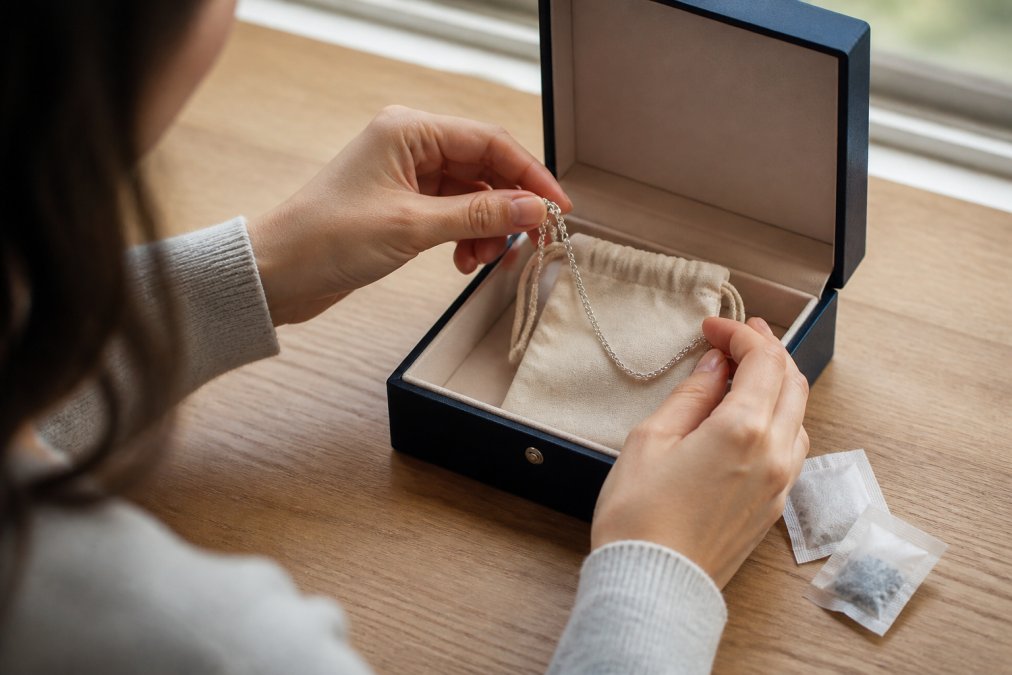
Anti-tarnish products do not coat the silver; they change the air around it. Treated fabric, paper and strips are impregnated with compounds that react with sulfur-containing gases before those gases reach the metal, so sulfur is captured in the lining rather than bonding to the copper. Once saturated, the lining stops scavenging sulfur and the chain tarnishes again.
Silica gel handles the other half: tarnish accelerates in humid air, so pulling moisture out of the container slows the chemistry. Silica gel is not a sulfur absorber, and an anti-tarnish strip is not a desiccant, you need both for long-term storage.
DIY storage works well as a system: a zip-lock bag with the air pressed out, an anti-tarnish strip and a silica packet will outperform an expensive open jewellery box for long-term storage. The trade-off is refreshing the consumables.
Professional solutions make sense for several pieces or high-value chains. A lined, gasketed jewellery box with individual compartments limits air exchange and stops chains tangling, which causes scratches and wear. The gasket is what matters: a lined box without a seal still exchanges air, so it only slows tarnish.
| Storage Method | Best For | Cost | Maintenance |
|---|---|---|---|
| Zip pouch + anti-tarnish strip | Single chains, everyday wear | Low | Replace strip every 6-12 months |
| Lined jewellery box | Multiple pieces, rotation | Medium | Refresh strips periodically |
| Sealed container + silica gel | Long-term storage | Low | Replace silica when saturated |
| Professional compartment box | High-value collections | Higher | Check seals and strips regularly |
For a chain you wear often, a zip pouch inside a drawer is enough. For pieces stored for months, seal them with a strip and a silica packet, then check the packet every few months. A spent packet is worse than none because it gives a false sense of protection.
A practical sequence:
Australian Government guidance on precious metal hallmarks
The most effective tarnish prevention happens before your chain ever needs cleaning. Daily habits matter more than any single product, because tarnish builds from repeated small exposures rather than one dramatic event.
Take your chain off before the situations that expose it to sulfur, chlorine, or abrasion. A consistent removal habit prevents more tarnish than any polish.
The order matters. Apply cosmetics and fragrance first, let them dry, then put your jewellery on. Cosmetics and skin oils are among the most common causes of fast tarnishing on a chain worn daily.
Learning how to clean silver jewellery safely protects both the metal and any rhodium plating. The goal is to remove tarnish without abrading the surface, because scratches dull a chain permanently.
Start with the gentlest method and only escalate if needed:
A polishing cloth is the safest everyday tool. The treated inner cloth removes light tarnish; the outer cloth buffs and protects. Use it before tarnish becomes visible, not after.
What to avoid is just as important:
Chain design changes how quickly tarnish appears, how visible it is, and which cleaning method is safe, which matters when choosing a chain or deciding how to store it.
Box chains are built from tight, flat links with more surface contact and little airflow. Tarnish shows first on the flat faces, and the inner corners are hardest to reach, so a soft-bristle brush beats a cloth. Store them flat or loosely coiled; a tight coil traps moisture between the flat faces.
Snake chains have smooth, closely fitted links that look sleek but trap moisture and cosmetics between segments. They kink if stored loosely or hung, so coil them in a pouch or lay them flat. Soak longer and rinse thoroughly, because residue between segments accelerates tarnish from the inside. Never pull a snake chain straight to dry it.
Rope chains are twisted links with more open surface area and better airflow. They tarnish more evenly and clean easily, since a brush and rinse reach most surfaces. The twist can catch fibres and hair, so check the links before storing; they tolerate a light polishing cloth well.
Belcher and rolo chains have round, open links. They are the most forgiving to clean and least likely to hold trapped moisture, making them a sensible choice for daily wear in humid conditions. A quick wipe after each wear is usually enough.
Curb and figaro chains sit in the middle: enough open structure to clean easily, but enough flat surface to show tarnish when neglected. A Singapore chain is a twisted variant with a tighter structure, so it behaves more like a rope chain for cleaning but needs the same drying care as a snake chain. For all three, the practical rule is the same: dry thoroughly, store sealed, and brush rather than scrub.
| Chain Type | Tarnish Visibility | Cleaning Difficulty | Storage Note |
|---|---|---|---|
| Box | High on flat faces | Moderate | Store flat or loosely coiled |
| Snake | Low until advanced | High | Coil in a pouch, never hang |
| Rope | Even | Low | Check for trapped fibres |
| Belcher / Rolo | Even | Low | Wipe after each wear |
| Curb / Figaro | Moderate | Moderate | Dry fully before sealing |
Hallmarking guidance from the Australian Government
Five minutes a week prevents the deep tarnish that takes an hour to reverse. Preventative maintenance beats cleaning, because the less tarnish that forms, the less you have to remove.
The routine is deliberately short. A chain that gets wiped weekly rarely needs more than a light polish, while one left untouched for a season often needs a full clean.
Most tarnish damage comes from a handful of repeatable mistakes. Fix these and you remove the main causes.
At DP Online Syd, our hallmarked 925 sterling silver chains are built for everyday wear, and each piece comes with a lifetime warranty and arrives in protective packaging ready for storage. Free shipping applies on orders over $100.
Learning how to clean silver jewellery safely protects both the metal and any rhodium plating. The goal is to remove tarnish without abrading the surface, because scratches dull a chain permanently.
Start with the gentlest method and only escalate if needed:
A polishing cloth is the safest everyday tool. The treated inner cloth removes light tarnish; the outer cloth buffs and protects. Use it before tarnish becomes visible, not after.
What to avoid is just as important:
Chain design changes how quickly tarnish appears and how visible it is. This is the detail most care guides skip, and it matters when you are choosing a chain or deciding how to store it.
A Singapore chain or figaro chain sits somewhere in the middle, with enough open structure to clean easily but enough surface to show tarnish when neglected.

Hallmarking guidance from the Australian Government
Five minutes a week prevents the deep tarnish that takes an hour to reverse. Preventative maintenance beats cleaning, because the less tarnish that forms, the less you have to remove.
The routine is deliberately short. A chain that gets wiped weekly rarely needs more than a light polish, while one left untouched for a season often needs a full clean.
Most tarnish damage comes from a handful of repeatable mistakes. Fix these and you remove the main causes.
At DP Online Syd, our hallmarked 925 sterling silver chains are built for everyday wear, and each piece comes with a lifetime warranty and arrives in protective packaging ready for storage. Free shipping applies on orders over $100.
Wear it often, then wipe it with a soft polishing cloth before storing it in an airtight pouch or a lined jewellery box with a silica gel packet. Keep silver chains away from perfume, hairspray, chlorine and saltwater. A quick weekly wipe and dry storage is the simplest way to stop sterling silver chains from turning black between wears.
925 silver contains around 92.5% silver and 7.5% other metals, usually copper. When sulfur compounds in the air, sweat or cosmetics meet the surface, they form silver sulfide, which shows up as a black or grey film. Humidity and air exposure speed this up. It is surface tarnish, not damage, and it comes off with gentle cleaning.
Store each chain separately in an airtight anti-tarnish bag or a zip-lock pouch with a silica gel packet, then place it in a jewellery box away from sunlight and moisture. Add an anti-tarnish strip for longer storage. Avoid hanging chains in open air or leaving them in the bathroom, where steam and humidity accelerate tarnish.
Wearing sterling silver chains regularly can slow tarnish because the natural oils on your skin create a light protective layer. However, sweat, sunscreen and cosmetics can also speed it up if you never clean the chain. The reliable habit is to wear it, wipe it with a microfiber polishing cloth after each wear, and store it dry and airtight.
Tarnish is not a sign of poor quality; it is a chemical reaction that every sterling silver chain will face eventually. The difference is how well you defend against it. DP Online Syd stocks hallmarked 925 sterling silver chains with hypoallergenic finishes, a lifetime warranty, and packaging designed to protect your piece from the moment it arrives. Shop the collection and keep your silver bright for years.


 is here! Shop now, pay later in 4 easy installments